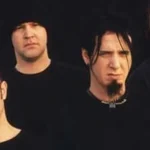
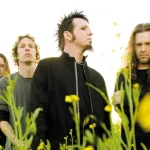
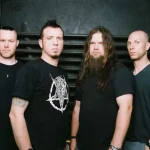
At the 2001 MTV Video Music Awards, the prize in the new MTV2 Award category went not to fashionable rap-rockers or another major-label protégé, but to four painted musicians from Illinois. In the video for Dig, vocalist Chad Gray looked like a creature from a freshly opened spaceship, guitarist Greg Tribbett sported a black-and-white mask, and bassist Ryan Martinie coaxed sounds from his instrument that were not normally included in the factory manual. Mudvayne became instantly recognizable. Behind the makeup, however, was much more complex music than one might expect from members of a carnival.
Mudvayne appeared in 1996 in Peoria—an industrial city located approximately 260 kilometers from Chicago. The original lineup consisted of drummer Matthew McDonough, guitarist Greg Tribbett, vocalist Chad Gray, and bassist Shawn Barclay. They started without any romance: rehearsal spaces, small clubs, and self-distributed recordings.
In 1997, the musicians released the EP Kill, I Oughtta. A year later, Barclay was replaced by Ryan Martinie, who had previously played in the progressive-rock band Broken Altar. This change defined Mudvayne’s future sound. Martinie treated the bass guitar not as a background instrument, but as a separate character: he snapped at the strings, built jazz passages, and argued with the guitar riff instead of obediently doubling it.
A contract with No-Name Management and Epic Records took the quartet beyond the local scene. The debut album L.D. 50 was recorded with producer Garth “GGGarth” Richardson, who had worked with Rage Against the Machine. The executive producer was Shawn “Clown” Crahan of Slipknot, whose career was gaining momentum after the release of the band’s self-titled 1999 album.
The title L.D. 50 comes from the toxicological term “lethal dose 50%”—the amount of a substance capable of killing half of a test group. The album was released on August 22, 2000, and proved strange even by the standards of the nu-metal era. Sound collages, speech fragments, and noisy interludes appeared between songs, while the time signatures changed just when the listener was preparing for a familiar chorus.
Dig was built on a choppy riff and Gray’s almost inhuman growl. Death Blooms had an entirely different nature: the vocalist wrote it after witnessing his grandmother’s illness and the way relatives treated the aging woman. Behind the makeup and stage aliases was a song not about monsters, but about helplessness, old age, and family indifference.
L.D. 50 reached No. 1 on the Billboard Heatseekers chart and No. 85 on the Billboard 200, later receiving an RIAA platinum certification. Mudvayne were placed in the nu-metal section alongside Slipknot and Korn, although Martinie’s jazz bass and McDonough’s mathematical playing did not fit neatly into that box.
The musicians recorded their second album, The End of All Things to Come, at Pachyderm Studio in Minnesota—the same studio where Nirvana worked on In Utero. The producer was David Bottrill, known for his collaborations with Tool, King Crimson, and Peter Gabriel. The record was released in November 2002 and climbed to No. 17 on the Billboard 200.
On Not Falling, World So Cold, and the title track, the quartet retained its sharp contrasts but made the song structures clearer. The stage costumes changed as well: at first, the musicians portrayed creatures with white faces and black suits, then adopted images reminiscent of science-fiction characters. Gradually, there was less paint. By the middle of the decade, Mudvayne had almost completely abandoned the makeup—at last, the music no longer had to compete with choosing cosmetics.
The third studio album, Lost and Found, appeared on April 12, 2005. Dave Fortman, who had previously produced Evanescence, was behind the console. The recording was more compact than its predecessors: fewer interludes, more direct choruses, while the complex parts were hidden inside accessible song structures.
The result was immediate. Lost and Found debuted at No. 2 on the Billboard 200, selling approximately 100,000 copies in its first week. The single Happy? became one of Mudvayne’s biggest radio hits, while Forget to Remember appeared on the soundtrack to the film Saw II. The eight-minute Choices, however, reminded listeners that the band had not yet turned into a factory for three-minute action songs.
At the same time, Gray and Tribbett launched Hellyeah with former Pantera drummer Vinnie Paul. At first, the project looked like something to do between tours, but over time it became a full-fledged band. It would later play a significant role in Mudvayne’s disappearance.
In 2007, the compilation By the People, for the People was released, with its contents selected by fans. It included live recordings, demos, and a cover of King of Pain by The Police. Then the quartet suddenly accelerated: The New Game appeared in November 2008, followed by the self-titled Mudvayne in December 2009.
The New Game reached No. 15 on the Billboard 200, but critics received it cautiously. The songs became more straightforward, and the familiar formula began to repeat itself. The next record was at least physically more curious: the cover of Mudvayne was printed with special ink visible only under ultraviolet light. Without the proper lamp, the buyer received an almost blank white sleeve. Impressive. And not particularly convenient.
After the 2010 tour, Mudvayne’s activity effectively stopped. There was no dramatic official breakup with mutual accusations. Gray and Tribbett focused on Hellyeah, McDonough later formed Audiotopsy, and Martinie took part in various projects, including the progressive trio Soften the Glare. The members periodically discussed a possible return, but gave no specific dates.
The hiatus dragged on. During that time, nu metal went from an object of ridicule to another subject of nostalgia, festivals once again began assembling early-2000s lineups, and young bassists continued studying Martinie’s parts in slowed-down videos.
In April 2021, Mudvayne announced a reunion for a series of festival appearances. Gray, Tribbett, Martinie, and McDonough stood onstage together again after an eleven-year hiatus. The first shows were uneven: the vocalist needed to regain his form, while the audience filmed every mistake on their phones. By the following season, the quartet had already embarked on the Freaks on Parade tour with Rob Zombie, Static-X, and Powerman 5000.
In 2023, Mudvayne mounted their own U.S. tour, The Psychotherapy Sessions, inviting Coal Chamber, GWAR, Nonpoint, and Butcher Babies. The name referred to the first line of Dig. There was still no new material, and the comeback could have remained exclusively a live enterprise.
On August 28, 2025, the band released Hurt People Hurt People—their first new song since the album Mudvayne. The producer was Nick Raskulinecz, who had worked with Foo Fighters, Deftones, Korn, and Alice in Chains. Two weeks later, the single Sticks and Stones followed. Both recordings were released through Alchemy Recordings/BMG and became Mudvayne’s first material issued by a company other than Epic.
The comeback was characteristically tense. The initial mix of the singles drew complaints from listeners, after which updated versions appeared on streaming platforms. Even the release of the seven-inch record was delayed to allow additional work on the sound. After sixteen years of silence, Mudvayne returned not with a grand declaration of their own greatness, but with a revised mix—entirely in keeping with a band that had always enjoyed making things more difficult for itself.