


In the spring of 2000, rock radio stations received a song that began with the words “Cut my life into pieces.” There was no mysterious poetry, romantic haze, or safe teenage rebellion in it: Jacoby Shaddix sang about a nervous breakdown and suicide in almost documentary language. “Last Resort” topped the Billboard Modern Rock Tracks chart, while the album Infest climbed to No. 5 on the Billboard 200. For musicians from the small California town of Vacaville, it seemed impossible. Not long before, they had been distributing CDs themselves and playing wherever they could plug in their equipment.
The story of Papa Roach began in January 1993. High-school students Jacoby Shaddix and drummer Dave Buckner met on the school football field, started talking about music, and decided to perform at a talent show. They were joined by bassist Will James and trombonist Ben Luther. The newly formed group played its own version of Jimi Hendrix’s “Fire.” They did not win the contest. But they did not split up after losing—a rare outcome for a school band assembled almost on the spot.
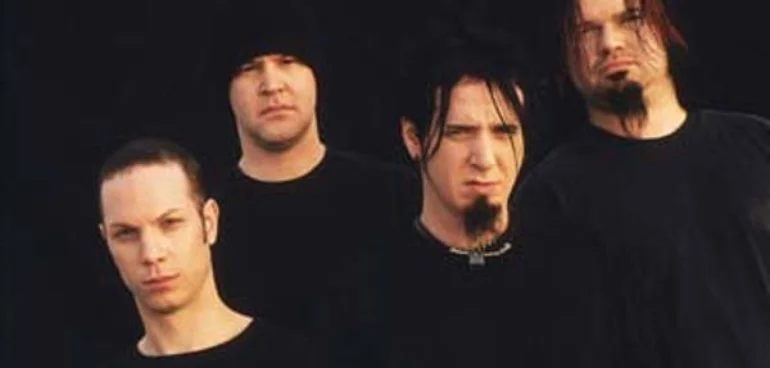
The name came from one of Shaddix’s relatives, Howard William Roatch, who was known in the family as Papa Roach. The joke stuck better than many carefully designed rock ’n’ roll names. Guitarist Jerry Horton soon joined the lineup, and in 1996 Tobin Esperance replaced Will James. This created the quartet that recorded Papa Roach’s best-known work: Shaddix, Horton, Esperance, and Buckner.
The musicians released demos and EPs with their own money, combining rap delivery, funk-metal bass, and heavy guitar riffs. In 1997, they released the independent full-length album Old Friends from Young Years. The sound was rough, at times almost garage-like. But the songs already revealed Shaddix’s defining trait: he did not hide family trauma and addiction behind abstractions.
In 1999, Papa Roach signed with DreamWorks Records and went to Hollywood’s NRG Studios. The producer was Jay Baumgardner, who had worked with Helmet and Sevendust. Some of the material had already existed in independent versions, but for Infest, the songs were re-recorded, made heavier, and assembled into a denser album. The release arrived on April 25, 2000—at a time when Limp Bizkit, Korn, and early Linkin Park were turning nu metal from a club scene into a major music business.
Infest spent 65 weeks on the Billboard 200, including 11 weeks in the top ten. In December 2024, the RIAA raised the album’s U.S. certification to four-times platinum. According to the label, worldwide sales exceeded seven million copies. “Last Resort” was followed by “Broken Home” and “Between Angels and Insects”—songs about a broken family, alienation, and the race to consume. Papa Roach also received a Grammy nomination for Best New Artist, although the award went to Shelby Lynne.
Success had an unpleasant underside. “Last Resort” quickly became the mandatory finale of every concert, while journalists filed the musicians alongside dozens of other nu-metal newcomers. The question was simple: what would remain when the fashion for rapping over guitars ended?
The answer was Lovehatetragedy, released in 2002. Brendan O’Brien, the producer of Pearl Jam, Stone Temple Pilots, and Rage Against the Machine, was behind the console. The rap passages became less prominent, Horton received more room for guitar parts, and Shaddix began singing more often instead of rapping. The record reached No. 2 on the Billboard 200, but could not match the sales of Infest. It was a commercial decline and, at the same time, a useful turn: Papa Roach were no longer prisoners of a single MTV season.
The transition continued on 2004’s Getting Away with Murder. The producer was Howard Benson, who would later work with My Chemical Romance and Three Days Grace. The title track sounded hard and focused, but the biggest hit was the ballad “Scars.” It climbed to No. 15 on the Billboard Hot 100—higher than any other Papa Roach single. The irony was obvious: a band famous for nervous rap metal scored its biggest pop hit with a song built around acoustic guitars and an almost mainstream chorus.
The Paramour Sessions was recorded at Paramour Mansion in Los Angeles’s Silver Lake neighborhood. The album was released in 2006, with “...To Be Loved” and “Forever” emerging as its key tracks. The historic house, once associated with Hollywood aristocracy, gave the sessions a beautiful setting, but things inside the band were far less romantic.
In 2007, Dave Buckner temporarily stopped touring because of personal problems, then left Papa Roach permanently. Tony Palermo, who had previously played in Unwritten Law, replaced him. Losing a founder could have destroyed the band: Buckner had been part of it since the high-school talent show and had shaped the character of the early recordings. It did not fall apart. Palermo proved to be a more direct and powerful drummer, something clearly audible on 2009’s Metamorphosis.
Jay Baumgardner returned for the record, while James Michael served as co-producer. Mick Mars of Mötley Crüe played the solo on “Into the Light.” The single “Lifeline” topped the American Mainstream Rock chart, confirming the new reality: Papa Roach no longer depended on nu metal, which by the end of the decade had disappeared from the center of popular culture.
During the 2010s, the musicians began treating genres in almost purely practical terms. 2012’s The Connection combined heavy riffs with electronic programming; the material was recorded partly at The Red House studio in Sacramento with the participation of James Michael and John Feldmann. On 2015’s F.E.A.R., the quartet worked with Kevin and Kane Churko in Las Vegas. The title stood for Face Everything and Rise.
The phrase did not sound like an advertising slogan. For years, Shaddix had spoken about his struggle with alcoholism, while the lyrics returned to depression, family conflict, and attempts to remain sober. In 2012, the vocalist underwent surgery on his vocal cords. Shows had to be canceled. For a frontman whose style depended on screaming and constant physical strain, it was a very literal professional crisis.
2017’s Crooked Teeth brought rap verses back into the music, but without trying to reconstruct 2000 exactly. Skylar Grey appeared on “Periscope,” while rapper Machine Gun Kelly featured on “Sunrise Trailer Park.” This was followed by 2019’s Who Do You Trust?, where guitars stood alongside pop production and electronics. Not all the experiments were equally convincing: at times, the processing smoothed away the nervous roughness that made Papa Roach worth listening to in the first place. Still, the band had never promised to preserve the genre in museum condition.
The eleventh studio album, Ego Trip, was released on April 8, 2022, through the band’s own label, New Noize Records. Alternative metal, punk, electronics, and rap rock came together on the record; individual songs were produced by Colin Brittain, Nick Furlong, and Jason Evigan. “Kill the Noise” reached the top of the Billboard Mainstream Rock Airplay chart. Two decades after Infest, Papa Roach had another radio hit without trying to write a second “Last Resort.”
The current lineup has remained unchanged since the late 2000s: Jacoby Shaddix—vocals, Jerry Horton—guitar, Tobin Esperance—bass and programming, Tony Palermo—drums. In 2023, the band celebrated its 30th anniversary. Then, in December 2024, “Last Resort” received a six-times-platinum RIAA certification—the song about personal despair continued accumulating millions of sales and streams in an era when the compact disc that once made Papa Roach famous had itself become almost a museum piece.