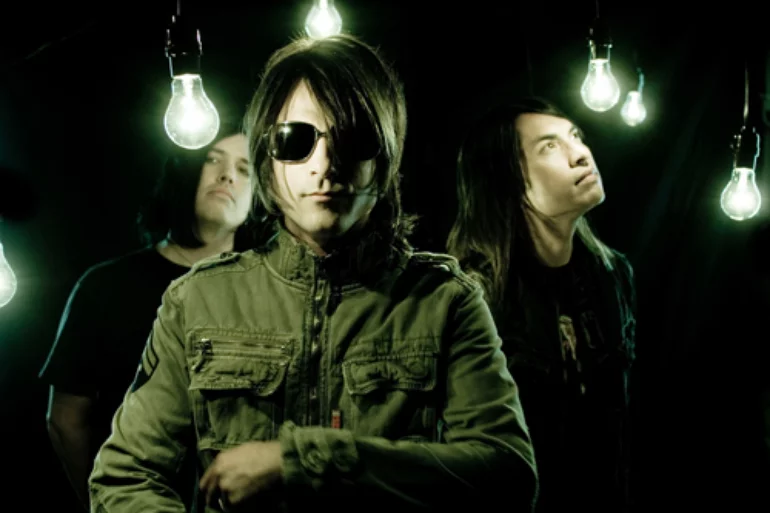
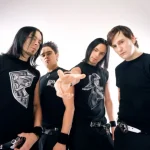

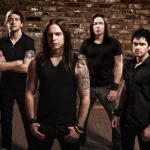
Before the name Bullet for My Valentine appeared, four teenagers from the Welsh town of Bridgend played under the name Jeff Killed John. It was 1998: nu metal was rapidly taking over radio stations, Metallica was fighting Napster, and the British heavy-music scene was looking for an answer to America’s Korn and Limp Bizkit. Matt Tuck, Michael “Padge” Paget, Michael “Moose” Thomas, and bassist Nick Crandle recorded demos, played local venues, and tried to attract record labels. It did not go particularly well.
Jeff Killed John managed to release several demos, including You/Play with Me, but a record deal fell through. The musicians abandoned the fashionable rapped verses, became more heavily influenced by Metallica, Iron Maiden, and Slayer, and changed their name in the process. For a while, they considered the name Opportunity in Chicago, but the more cinematic Bullet for My Valentine won out. The name proved fitting: it simultaneously suggested teenage melodrama and a metal threat—the two main ingredients of the quartet’s future songs.
Nick Crandle left before the band began serious studio work. Jason “Jay” James took his place, and with this lineup Bullet for My Valentine signed with the British label Visible Noise. The self-titled EP was released in November 2004; the American edition appeared on Trustkill Records under the title Hand of Blood.
The title track received unexpectedly powerful promotion through video games. Hand of Blood appeared in Need for Speed: Most Wanted and Burnout Revenge, where its choppy guitar riff perfectly accompanied virtual crashes. For a band from a small industrial town, this placement proved more useful than dozens of club posters: the song reached an audience that might never have read the metal press at all.
The debut album, The Poison, was released in the United Kingdom on October 3, 2005. It was produced by Colin Richardson, who had previously worked with Carcass, Machine Head, and Fear Factory. He did not bury the melodies beneath a layer of guitar noise: Paget and Tuck’s twin solos stood alongside sharp breakdowns, while clean vocals shifted into screams without warning.
Tears Don’t Fall, All These Things I Hate (Revolve Around Me), and 4 Words (To Choke Upon) turned the musicians into heroes of the MySpace generation. The lyrics were direct, sometimes almost diary-like—infidelity, jealousy, anger, and broken relationships. No mystery. But the choruses worked without fail.
The Poison sold enough copies to earn gold certifications in both the United Kingdom and the United States. The album reached No. 21 on the UK chart, although its heavy material was poorly suited to ordinary radio airplay. Bullet for My Valentine embarked on an extensive tour, performed at Download Festival, and toured the United States with Rob Zombie.
The pace nearly ended in disaster. In 2007, Matt Tuck developed serious problems with his tonsils. The vocalist underwent surgery, forcing the band to cancel a number of shows, including a concert at London’s Wembley Stadium, where the Welsh musicians were scheduled to open for Metallica. For musicians who had grown up on Master of Puppets, the cancellation seemed especially cruel.
After recovering, Tuck returned to the studio. The second album, Scream Aim Fire, again recorded with Colin Richardson, appeared in January 2008. It debuted at No. 4 on the Billboard 200 and No. 5 in the United Kingdom. The music became faster and drier, while the influence of thrash metal moved to the forefront. Tuck’s vocal parts had to be built more carefully, however: after the surgery, he had to relearn his screaming technique.
For 2010’s Fever, the quartet changed producers. Don Gilmore, known for his work with Linkin Park, made the sound cleaner and more accessible. The album reached No. 3 on the Billboard 200, while the songs Your Betrayal and The Last Fight became fixtures in the live set. This was the peak of their commercial form: the complex guitar parts had not yet given way to radio-oriented choruses, but the rough edges of the debut had already disappeared.
The follow-up was less convincing. Temper Temper was recorded with Gilmore and released in 2013. Some of the material was created while Tuck was working with the supergroup AxeWound, and Bullet for My Valentine noticeably simplified their arrangements. The response was cool: listeners criticized the repetitive lyrics and safe production. The album sold respectably, but for the first time it seemed that the band was chasing its own formula rather than developing it.
In February 2015, bassist Jay James left the lineup. The official statement offered no details, although the split clearly had not been planned as part of the promotional campaign. Jamie Mathias, who had previously played in Revoker, became the new bassist. Together with producers Colin Richardson and Carl Bown, the musicians recorded Venom.
The record brought back the fast riffs, guitar harmonies, and aggression of the early releases. It reached No. 3 on the UK chart and No. 8 on the Billboard 200. The title track, No Way Out, and You Want a Battle? (Here’s a War) sounded like a deliberate attempt to erase the aftertaste of Temper Temper. The attempt worked, although the old teenage urgency was gone—the musicians were now in their thirties, and pretending to be involved in high-school drama was becoming awkward.
In 2016, Michael “Moose” Thomas temporarily stopped touring to spend more time with his family. Jason Bowld filled in for him, and Thomas’s departure was confirmed permanently in December 2017. Tuck and Paget were now the only members who had been playing together since the days of Jeff Killed John.
The 2018 album Gravity marked the sharpest stylistic turn in Bullet for My Valentine’s history. Electronic textures, synthesizers, and extremely simple riffs pushed metalcore into the background. Tuck wrote the lyrics after his divorce and spoke about depression, so behind the polished sound was fairly bleak material. Longtime fans debated whether the quartet had turned into an alternative-rock band. Judging by the musicians’ interviews, that was exactly the kind of debate they wanted.
The seventh record received the simple title Bullet for My Valentine and was released in November 2021. Producer Carl Bown helped the band assemble perhaps the heaviest material of their entire career. Knives, Parasite, and Shatter almost abandoned the romantic melodicism of The Poison in favor of down-tuned guitars, Bowld’s dense drumming, and Tuck’s angry vocals.
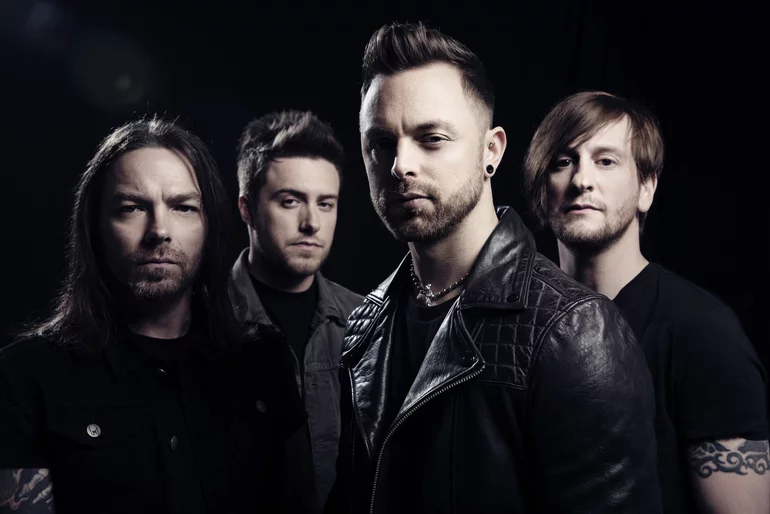
In the live lineup, Jamie Mathias and Jason Bowld settled in alongside Matt Tuck and Padge Paget. But the end of the show often takes the musicians back to 2005: the audience recognizes the opening notes of Tears Don’t Fall faster than it recognizes material from the newer albums. A song about a failed relationship proved more durable than several lineups, production concepts, and the once-omnipotent MySpace.